While CA Dems Harris and Newsom languish in the polls, Rep. Alexandria Ocasio-Cortez is ascendant. Can she succeed where Bernie Sanders failed? Or will she too be defeated by the Democratic Party machine?
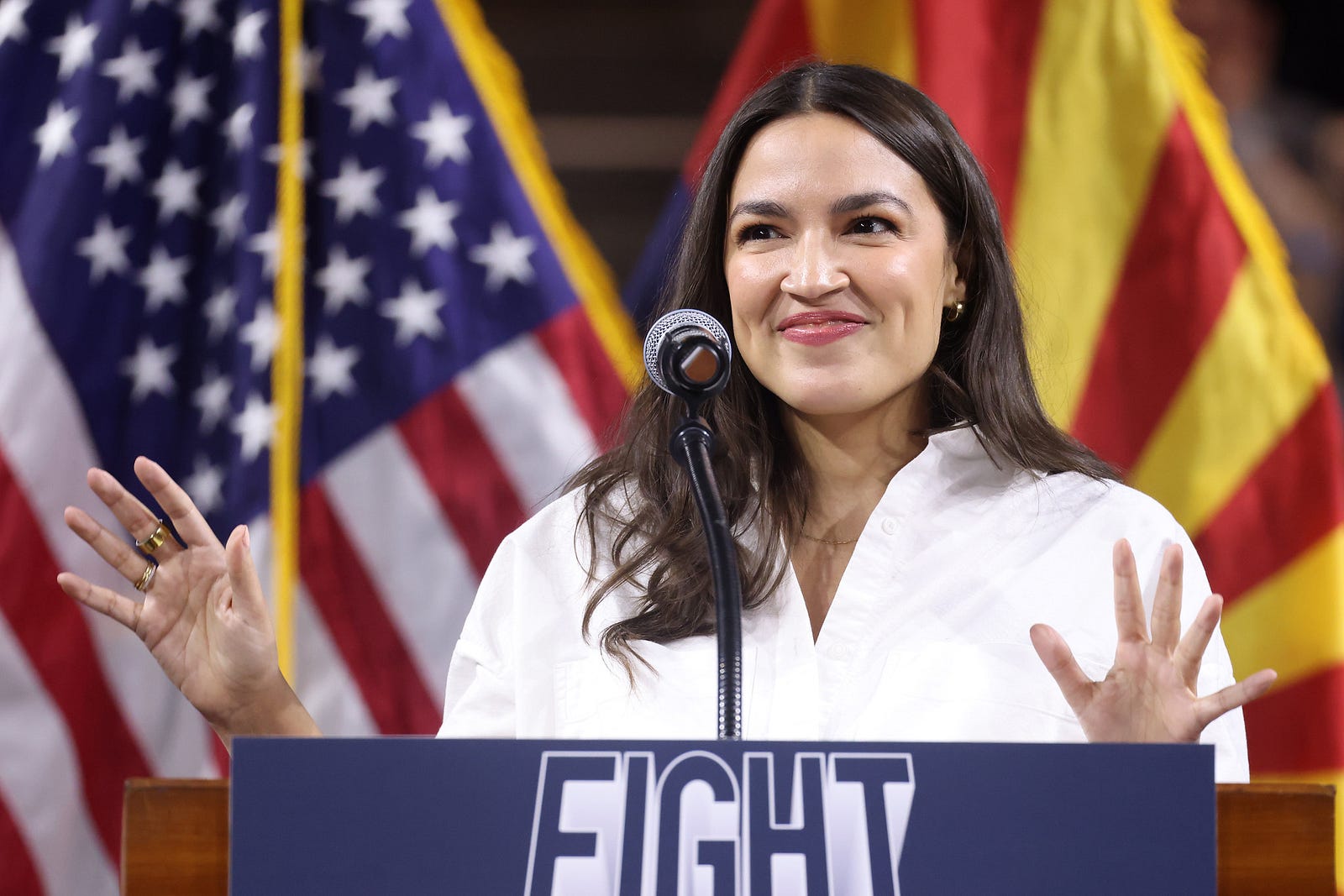
Alexandria Ocasio-Cortez is beginning to look less like the Democratic Party’s most famous young congresswoman and more like a plausible presidential candidate.
That does not mean she is destined for the White House. It may mean she is destined to become the next Bernie Sanders: enormously influential, exceptionally good at raising money and drawing crowds, capable of moving the party leftward — but ultimately unable to seize control of it.
Still, the latest polling deserves attention. A July Emerson College survey placed AOC at 13 percent in a hypothetical 2028 Democratic primary, ahead of former Vice President Kamala Harris at 8 percent and tied with Sen. Jon Ossoff. Gavin Newsom remained ahead of her at 17 percent, but that represented a substantial decline from the 25 percent he received in the same pollster’s August 2025 survey. AOC, meanwhile, had climbed from just 4 percent.
In New Hampshire, the traditional first presidential primary state, the picture is even more striking. A new University of New Hampshire survey placed AOC at the front of the prospective Democratic field, narrowly ahead of Pete Buttigieg. Her support was concentrated among voters who identify as progressives and socialists, suggesting both the intensity of her base and its potential limitations.
AOC’s ascent is occurring as the Democratic Party’s California establishment loses altitude.
Harris has already been tested nationally. Whatever affection Democratic voters may retain for her, losing a presidential election makes a second campaign harder. Newsom faces a different problem: He must defend California.
California remains one of the most productive and innovative places in the world. But it is also associated with prohibitively expensive housing, homelessness, high taxes, energy costs and years of highly visible government dysfunction. A May survey found 57 percent of Californians saying their state was headed in the wrong direction, while 76 percent expected bad financial times during the coming year. Newsom’s approval rating stood at a nearly even 50 percent approve and 48 percent disapprove. Cost of living, inflation, jobs and housing overwhelmingly dominated voters’ concerns.
That presents Newsom with a difficult national question: Why should Americans adopt California’s governing model when so many Californians appear dissatisfied with the results?
AOC does not carry that burden. She has never run a state or managed a large bureaucracy. She can promise sweeping change without answering for rising utility bills, failed housing policies or encampments under highway overpasses. Her lack of executive experience is a vulnerability, but during a primary it may also be an advantage. Newsom has a record. AOC has an argument.
And she has Bernie Sanders’s movement waiting for her.
Sanders built an extraordinary political infrastructure: small-dollar donors, activists, campaign professionals, sympathetic organizations and millions of younger voters who believe the Democratic establishment is too closely aligned with corporations and wealthy contributors. He changed the party’s language on health care, college debt, inequality and concentrated economic power.
But Sanders did not leave behind a throne. He left behind an insurgency.
His supporters often argue that the Democratic machine defeated him. There is substantial truth in that. Hillary Clinton entered the 2016 campaign with overwhelming establishment support. In 2020, party leaders rapidly consolidated around Joe Biden to produce his South Carolina victory. Pete Buttigieg and Amy Klobuchar withdrew and endorsed Biden just as Sanders appeared capable of emerging from a divided field with a delegate lead.
The machine closed ranks.
Yet blaming the machine alone lets Sanders escape responsibility for his coalition’s weaknesses. Democratic officials could organize endorsements, donors and institutional support, but they could not manufacture millions of votes. Sanders repeatedly struggled with older Democrats and Black voters, particularly in the South. His campaign predicted that young people and previously disengaged voters would enter the primaries in revolutionary numbers. They did not.
Analyses of the 2020 race found that Sanders failed to produce the turnout transformation on which his strategy depended and did not broaden his coalition enough beyond his most loyal supporters.
That is the inheritance AOC receives: tremendous enthusiasm, but no proven majority.
She may be better positioned than Sanders to expand it. She is younger, more comfortable in modern media and better connected to the Democratic Party’s female and minority constituencies. She can communicate progressive economics in direct, emotionally powerful language. Unlike Sanders, who often seemed almost defiantly indifferent to party relationships, AOC has shown signs of becoming more strategic about when to fight Democratic leaders and when to work with them.
But she also carries liabilities Sanders did not. She is closely identified with the Squad, democratic socialism and some of the left’s least popular positions on policing, immigration and Israel. Republicans would portray her as the national embodiment of New York’s activist left. She has not demonstrated that she can win a competitive statewide election, much less carry Pennsylvania, Wisconsin, Michigan or Arizona.
Her early polling may therefore reveal less about the Democratic Party’s ideological conversion than about its leadership vacuum. Harris represents a recent defeat. Newsom represents California governance. Other potential candidates remain little known or uninspiring. AOC, by contrast, stands for something recognizable.
That can be powerful in a crowded primary. A disciplined candidate with 20 percent of the party can defeat several conventional candidates dividing the remaining 80 percent — unless the establishment once again consolidates.
That is precisely the danger awaiting her. Democratic leaders may tolerate AOC as an activist, fundraiser and congressional celebrity while resisting her as a nominee. If she begins winning delegates, the party’s governors, donors, unions and elected officials are likely to rally behind whichever alternative appears most capable of stopping her.
But the machine only works when enough Democratic voters cooperate.
AOC’s challenge is not simply to overpower party officials. It is to persuade the voters Sanders never reached. She must prove that her movement can become broader without losing the intensity that made it powerful.
She is clearly Bernie Sanders’s heir apparent. The unanswered question is whether she will inherit his movement — or his ceiling.
(Contributing writer, Brooke Bell)